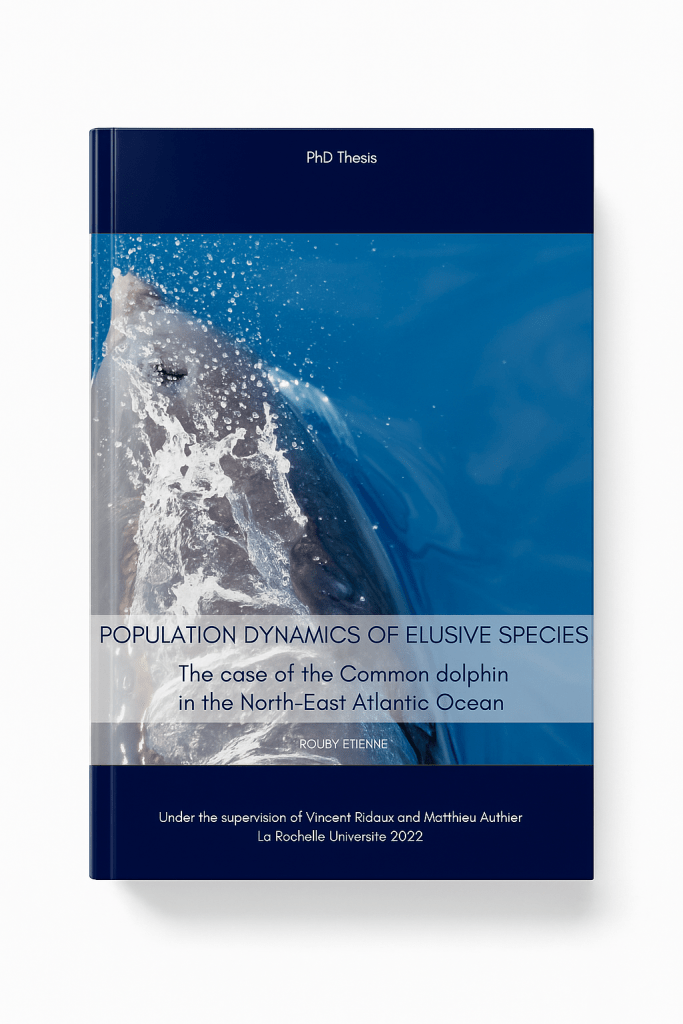
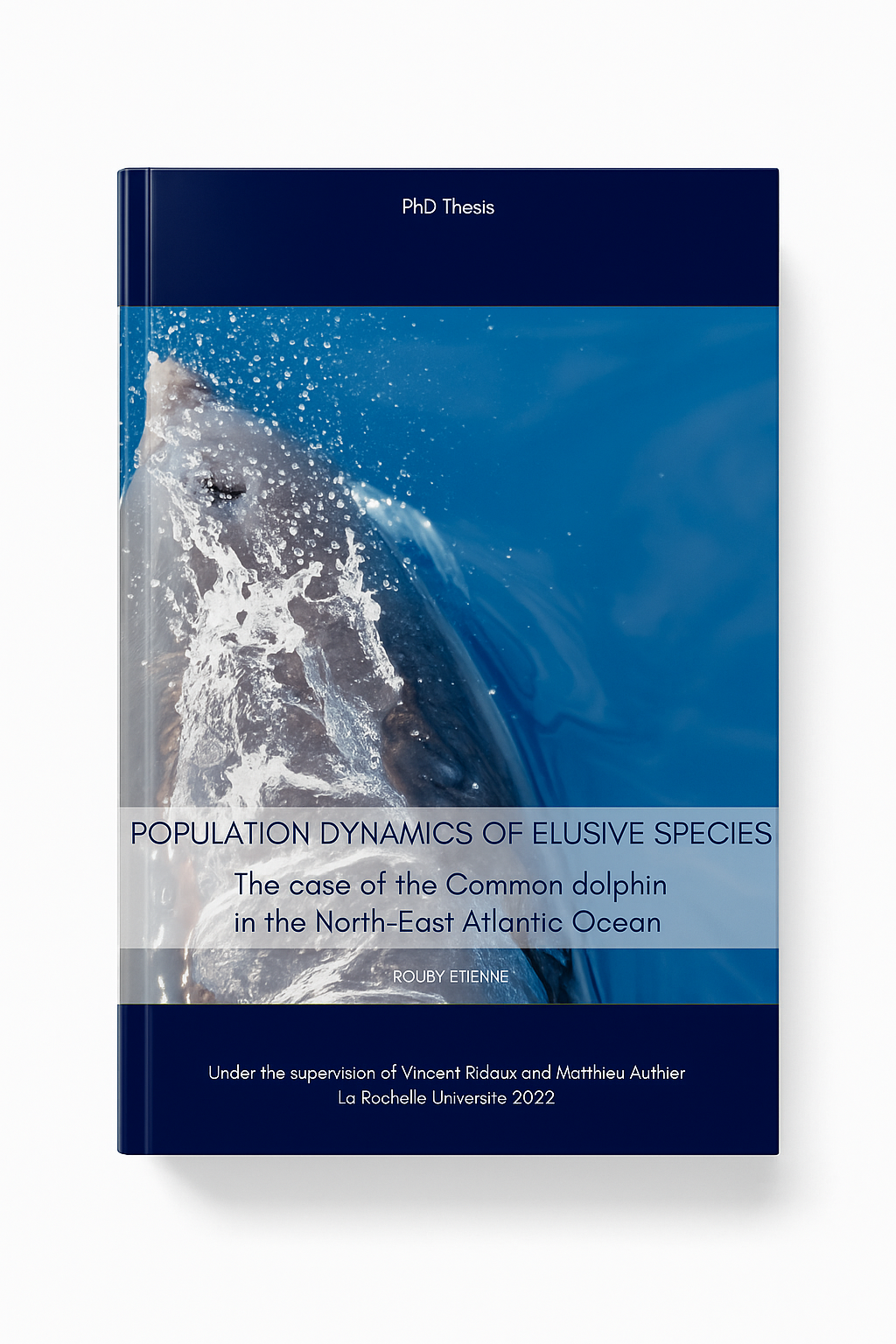
Population dynamics of elusive species : The case of the common dolphin in the North-East Atlantic Ocean
The story of the common dolphin (Delphinus delphis) in the North-East Atlantic Ocean. Approached with a demographic lens for the first time. From the strandings to the European Parliament. From demography to conservation.
Years of work and expertise. Available in a single document. In one click.
Download my Ph.D. Material
About the thesis
The Silent Struggle: Tracking the Invisible Giants of Our Seas
In the vast expanse of our oceans, some of nature’s most magnificent creatures remain tantalizingly beyond our grasp. These elusive species slip through the nets of scientific observation, their individual lives impossible to follow, their mortality rates shrouded in mystery—leaving conservationists struggling to craft the policies needed to protect them.
Among these marine phantoms, the common dolphin, Delphinus delphis, emerges as both emblematic and endangered. The Northeast Atlantic population faces a silent crisis: accidental captures in fishing nets that threaten to unravel the very fabric of their existence. Yet we know disturbingly little about their demographic reality, and our fragmentary understanding of when and where these tragic encounters occur leaves us unable to set meaningful conservation targets.
This groundbreaking study ventures into uncharted waters, seeking to determine whether this dolphin population can survive the gauntlet of human activity that surrounds it. Through the development of innovative methods that capture the ebb and flow of life and death across time, researchers have unveiled the hidden variations in survival rates and the devastating demographic impact of fishing mortality. The findings paint a troubling picture: this population teeters on the brink, its growth rate spiraling downward since the mid-2000s.
Drawing from sixteen years of observer data across ten maritime regions, the study quantifies the weekly toll of accidental captures with unprecedented precision. The culmination is a rigorous assessment of sustainable catch limits—a conservation roadmap aligned with European environmental objectives that may determine whether these dolphins continue to grace our seas or fade into memory.
Frequently Asked Questions
What is the bycatch crisis about?
Bycatch, the accidental capture of dolphins in fishing nets, has emerged as a major threat to common dolphins in the Bay of Biscay since the 1990s, with levels dramatically increasing since 2016. Between 4,000 to 9,000 common dolphins are accidentally killed by fishing activities each year in these waters, far exceeding sustainable levels. Thanks to this work, the population is now know to not be viable. Making this one of Europe’s most pressing marine conservation challenges.
How do scientists estimate dolphin deaths if they happen at sea?
This work developed innovative statistical methods to estimate bycatch from « non-representative samples », essentially making the most of limited and biased data from fishing boat observers and stranded dolphins on beaches. These approaches use advanced modeling techniques including « regularized multilevel regression with post-stratification » to extrapolate from small numbers of observed bycatch events to estimate the true scale of dolphin mortality across entire fishing fleets. The research also employs « reverse drift modeling » to trace stranded dolphins backward through ocean currents to determine where they likely died at sea, providing crucial evidence that most strandings result from fishing interactions.
Why are dolphins getting caught in fishing nets more often now?
Dietary analysis research suggests that dolphins and fisheries are increasingly competing for the same prey species, particularly pilchards and anchovies, in more coastal waters. Oceanographic studies reveal that environmental factors like water temperature, currents, and prey distribution create « hotspots » where dolphins and fishing boats are more likely to encounter each other. The research suggests that limiting fishing haul duration, especially in winter when interactions peak, could serve as an effective mitigation strategy.
What can be done to save the dolphins?
This research provides the scientific foundation for setting « sustainable bycatch thresholds », essentially speed limits for how many dolphins can be accidentally caught without driving the population to extinction. This work has already influenced European policy, with the European Commission issuing formal notices to France and Spain in 2020 and 2022 demanding better monitoring and conservation measures. The research identifies specific high-risk fishing areas and seasons, enabling targeted management approaches such as temporary fishing restrictions, modified gear requirements, or enhanced observer coverage during critical periods. However, immediate action is needed as current bycatch levels far exceed what the dolphin population can sustain.
 ETIENNE ROUBY (Ph.D)